

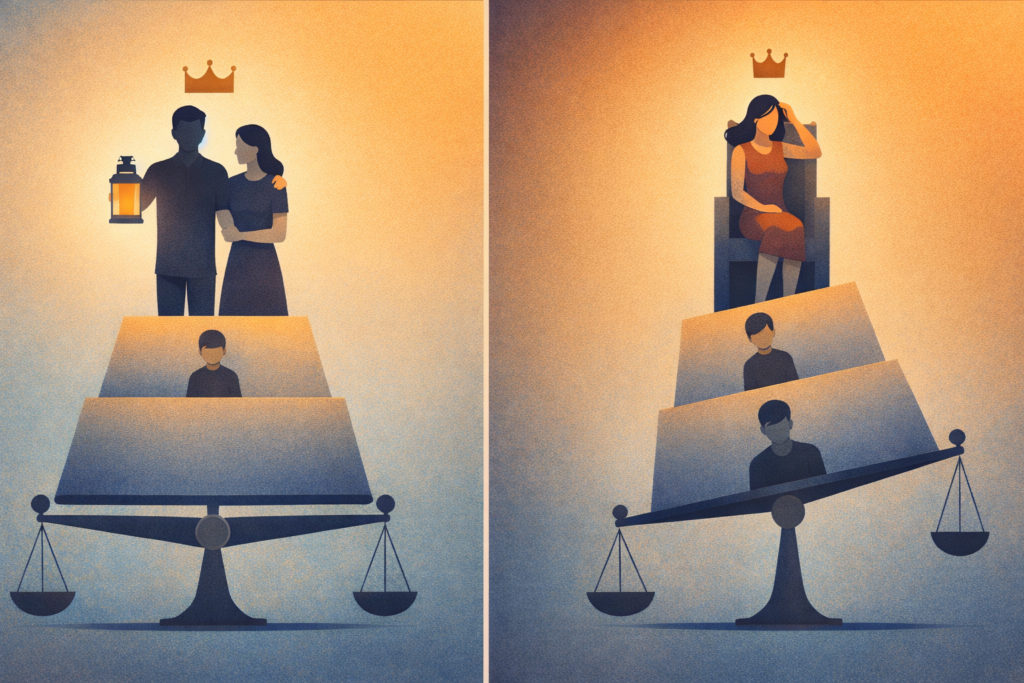
The development of male identity is shaped to a great extent by early relationships and the behavioural patterns a boy is exposed to in childhood. When a man is raised mainly, or exclusively, by his mother, without the presence of a stable male role model, it can later influence the way he approaches responsibility, authority, and his role within the family.
A child naturally adopts the behaviour he observes in his parents. This is not only conscious imitation, but also the formation of deep, often unconscious patterns that become activated especially in difficult life situations. Becoming a parent is one of the moments when these patterns often begin to show very clearly. A man suddenly finds himself in a position where he is expected to make decisions, handle pressure, and take responsibility — a role he may not have been naturally guided into.
No one can stand above the “leader”
When a man does not have an inner model of male leadership, he may unconsciously try to find that missing authority outside himself. He may look for someone above him — someone stronger and more decisive, someone who will take responsibility for difficult decisions and conflict situations.In the context of family life, this role may gradually be taken over by his partner. Not necessarily because she actively wants to lead, but because she has no other option.
One of the key consequences is the difficulty of facing demanding situations in adulthood. Taking responsibility always involves risk — the risk of failure, conflict, or not being seen as “the good one”. Simply put, it means rolling up your sleeves and being willing to get your hands dirty. When a man systematically avoids these situations, he places himself lower in the family structure. As a result, the natural order of responsibility becomes disrupted. Instead of the man taking the leading role, the partner is forced to take over, while he withdraws from responsibility.
Natural authority and the ability to lead a family
Authority is not the result of dominance. It comes from the ability to carry the consequences of one’s decisions. If a man does not take on this role, the family dynamic naturally reorganises itself. The so-called “imaginary throne” does not remain empty — it is taken by the person who is willing to face reality, act, and take responsibility.
From the perspective of family dynamics, it is therefore important for a man to take a leading position on a psychological and mental level. Leadership in this sense does not mean authoritarianism. It means clarity, stability, and the ability to remain oriented in difficult situations. A man who leads is not the one who is always right. He is the one who is willing to make decisions even in uncertainty, accept the consequences, and communicate with sensitivity.
A healthy family dynamic is not created through a fight for power, but through accepting one’s own role. For a man, this means stopping the search for someone “above him” and instead developing inner masculine strength. This strength is the foundation of a functional partnership, a safe family environment, and emotional stability within the whole family.
Igor Badáň
21.10.2025